Interdisciplinary approach
Work Packages
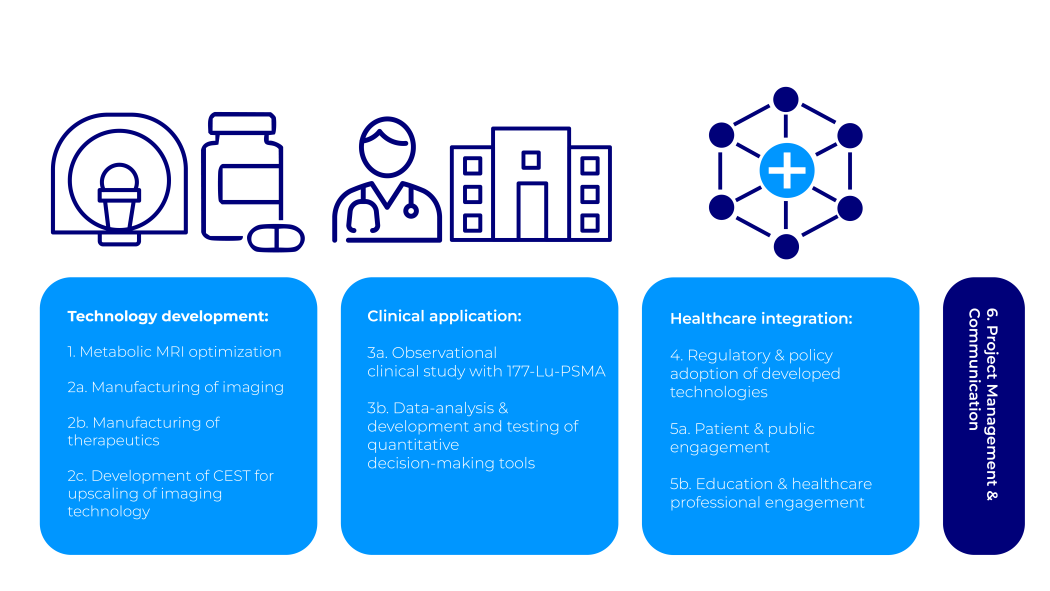
To realize its ambitions, ILLUMINATE has established 6 Work Packages. Together, these workstreams allow for large-scale development, evaluation and clinical validation, availability and adoption of improved theranostics.
Work Package 1 - Metabolic-MRI optimization
Partners involved: UMC Utrecht, Philips Medical Systems Nederland, Philips Gmbh Innovative Technologies, Tesla Dynamic Coils, Wavetronica, Lund University, Amsterdam UMC, Essen University Hospital
This Work Package will deliver the necessary MRI techniques to monitor disease progression and treatment response for metastatic prostate cancer. These include motion-robust and high SNR (signal-to-noise) metabolic-MRI including Compressed Sensing and AI-augmented reconstruction methods (CEST), fat-fraction and diffusion imaging.
Metabolic-MRI will be advanced from availability at a single institute as Proof of Concept towards multi-centre clinical investigation-ready integrated systems. Advances in CEST methodologies to detect pH changes include AI-augmented denoising, motion-robustness, and accurate spectral deconvolution.
The objectives of this Work Package include:
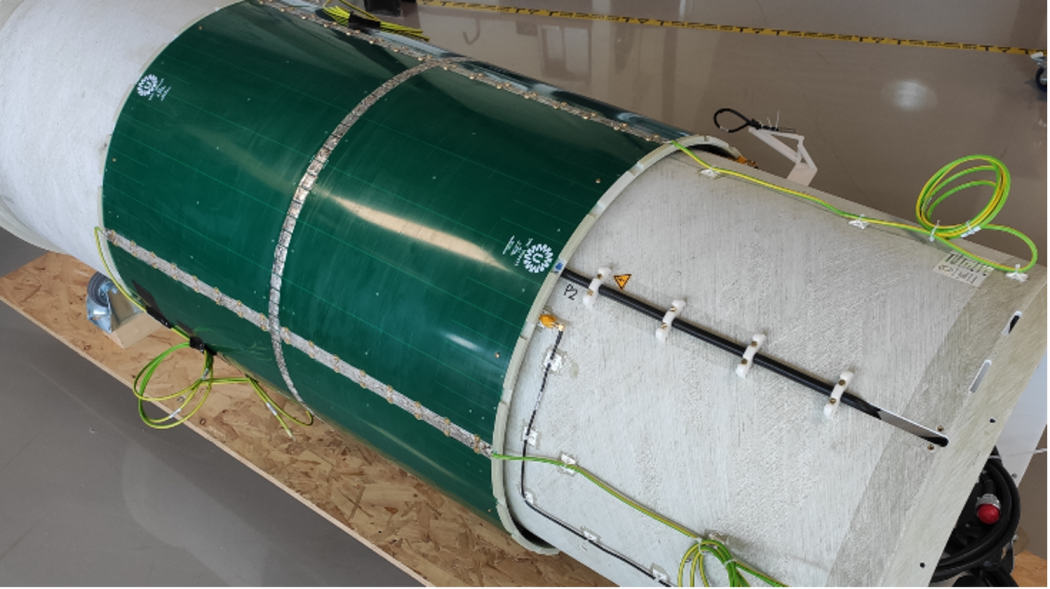
- Update of metabolic-MRI hardware and system integration
- Optimization of anatomical, functional and metabolic-MRI methods for upscaling
- Development of a technical clinical protocol and assuring quality assurance
Work Package 2 - Optimizing processes and improving scalability of technologies
Partners involved: NRG PALLAS, Philips Medical Systems Nederland, Philips Gmbh Innovative Technologies, Tesla Dynamic Coils, Wavetronica, Synlab Sdn Spa, Consiglio Nazionale Delle Ricerche, University of Turin, Bracco Imaging Spa
The goals of this Work Package are to increase and optimize manufacturing and to improve the scaling capabilities of the technologies used in ILLUMINATE. This will be done by developing a coordinated systems approach across the technology value chain to ensure affordable and sustainable access to the innovations of the ILLUMINATE consortium.
To this end, Work Package 2 will:
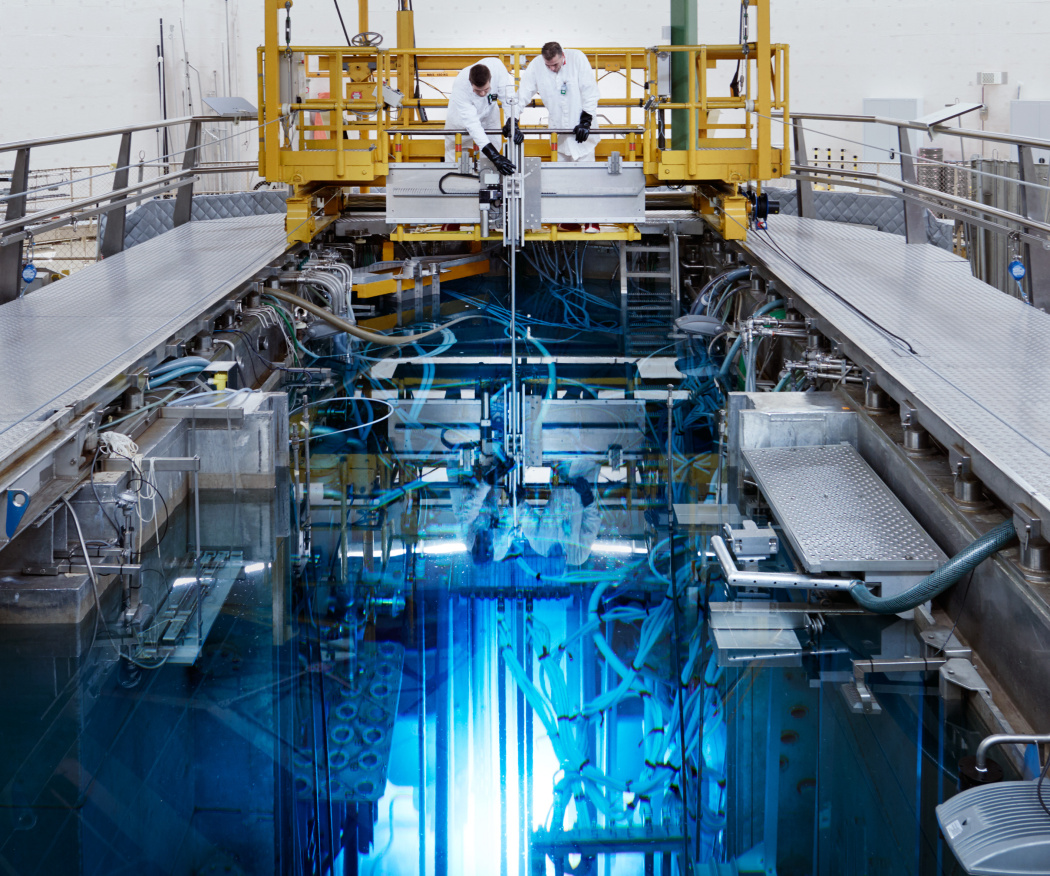
- Develop a reliable supply chain for theranostic production with Lu-177 as a demonstrator.
- Increase the availability of medical isotopes in EU by 1) increasing the production capacity of Lu-177, 2) improving the recycling of ytterbium, and 3) improving the central preparation of final medical isotopes.
- Facilitate affordable access to metabolic-MRI through a software platform strategy.
- Improve MRI-CEST protocols for assessing metabolism, tumour pH imaging and assessment of the water molecule transport across the cell membrane. This will support the upscaling of imaging technologies by facilitating translation of metabolic-MRI findings at 7T to 3T and 1.5 platforms.
Work Package 3 - Clinical study and data analysis
Partners involved: UMC Utrecht, Lund University, Amsterdam UMC, Essen University Hospital, NRG PALLAS
ILLUMINATE will conduct a multi-centre observational study in Essen (Germany), Utrecht (the Netherlands) and Amsterdam (the Netherlands). The study will recruit 150 patients with metastatic castrate-resistant prostate cancer, who receive lutetium-177-PSMA treatment according to routine clinical care.
In addition to this routine care, ILLUMINATE will add metabolic-MRI to the imaging regimen as a multimodal (PET/CT and metabolic-MRI) theranostics approach. According to routine clinical care, patients will receive up to six cycles of lutetium-177-PSMA with an interval of 6-9 weeks. PSMA PET/CT will be performed at baseline and after every two cycles for response analyses. Metabolic-MRI will be performed at the same timepoints as PSMA PET/CT.
The primary objectives of the clinical study are to:
- Investigate changes in metabolites using metabolic-MRI during treatment with lutetium-177-PSMA of patients with metastatic prostate cancer.
- Evaluate the data and investigate whether these changes measured with metabolic-MRI can independently predict treatment outcome.
- Develop and test quantitative decision-making tools.
The figure below illustrates the envisioned ILLUMINATE study. It shows the standard clinical treatment dose deliveries and PET scans, including the additional metabolic-MRI sessions during treatment.

WP4 - Regulatory & policy adoption
Partners involved: Philips Medical Systems Nederland, NRG PALLAS, Lund University, Essen University Hospital, Amsterdam UMC, Tesla Dynamic Coils, Wavetronica, Lygature
This Work Package focuses on activities that support the regulatory approval of ILLUMINATE’s procedures. These include:
- Development of a regulatory strategy for radionuclide-based theranostics envisioning interactions with various national health authorities and the European Medicine Agency.
- Research into the treatment policies of lutetium-treated patients in different EU countries. This could inform policy making, and might help reduce healthcare costs, increase patient satisfaction, and improve wider treatment availability.
- Providing non-binding and independent advice to the national authorities responsible for national reimbursement with the goal to facilitate adoption of optimized theranostics care pathways.
- Development of a guideline for in-house manufacturing of in vivo metabolic profiling on a 7T MRI scanner.
ILLUMINATE envisions that the scientific evidence from its clinical study, the experiences from the Stakeholder Involvement Community, and the improved treatment availability will help inform policy to make the (optimized) lutetium-177-PSMA treatment standard of care.

WP5 - Patient and public engagement & Education for healthcare professionals and scientists
Partners involved: UMC Utrecht, Synlab Sdn Spa, University of Turin, Bracco Imaging Spa, Lund University, Amsterdam UMC, Essen University Hospital, NRG PALLAS, Euro-BioImaging ERIC, Consiglio Nazionale Delle Ricerche, Lygature
ILLUMINATE aims to deliver impactful evidence-based clinical research outputs. To maximize the impact of its results, ILLUMINATE will engage with healthcare professionals, scientists, patients and members of the public.
- Engagement with healthcare professionals will seek to further validate the innovative approaches developed in ILLUMINATE as key tools for improving patient management and treatment outcomes.
- Involving the scientific community will contribute to the development of future innovative solutions and the proper exploitation of project results.
- Collaboration with patients and members of the public will ensure that the medical and technological capabilities developed in ILLUMINATE correspond with the needs and priorities of people affected by cancer. To this end, the project will form a stakeholder community composed of two groups: 1) patient-clinician partnerships locally embedded at each clinical study site, and 2) patient and patient relative representatives from national patient organisations and/or support groups.

WP6 - Program management and communications
Partners involved: Lygature, UMC Utrecht, Philips Medical Systems Nederland, NRG PALLAS, Euro-BioImaging, Amsterdam UMC, Essen University Hospital
Work package 6 will make sure that the different beneficiaries in ILLUMINATE can achieve something together that they could have never achieved alone. To this end, this workstream will:
- Ensure solid project management to support the participating partners and reach the project’s objectives.
- Coordinate the set-up of a sustainability plan, to ensure that what is developed can carry impact beyond the project.
- Design and implement a communication and dissemination plan to raise awareness, effectively engage stakeholders, inform of project progress and disseminate project results.
- Ensure the consortium’s contractual duties are carried out, including responsibilities towards the funder.