


Research
Metabolic-MRI
The ILLUMINATE consortium will demonstrate the unique value of recently developed Metabolic Magnetic Resonance Imaging (MRI) to improve effective application of theranostics. Metabolic-MRI makes it possible to combine therapy and diagnostics, called theranostics.

Recent studies have demonstrated that metabolic-MRI can be used to rapidly and repeatedly assess heterogeneity in tumour persistence and treatment response. Metabolic-MRI can visualize the chemical reactions happening in the body via spectroscopy that is performed during the scan. Therefore, this technique can be used to visually detail the characteristics of a tumour and to determine how it responds to Lu-177 treatment.
Current techniques such as PET or CT scans do not offer these capabilities. Metabolic-MRI offers the capabilities to assess treatment resistance in cancer through the possibility to repeatedly acquire 3D in vivo data of multiple relevant biological indicators like increased cell proliferation and inefficient energy metabolism, and the ability to capture tissue heterogeneity. These capabilities will be further developed in ILLUMINATE to a level necessary for routine clinical use in prostate cancer patient care.

Advantages of metabolic-MRI
Metabolic-MRI has technological advantages over techniques that are currently used in clinical practice. Via metabolic-MRI it is possible to capture multiple biological cancer signatures to assess tumour metabolism and resistance:
- The energy metabolism of the tumour can be detected, which tells something about the activity of the tumour.
- Tumours consist of cells that are dividing (proliferating) more often than healthy cells, making tumours often more dense than healthy tissues. Therefore, information on the proliferation and cell density can provide crucial information about the tumour and how it responds to treatment.
- Metabolic-MRI can visualize the tumour microenvironment. Tumours are often creating an environment around them that is different than that in healthy tissues and this can influence how a tumour responds to treatment.
Therefore, metabolic-MRI provides a better insight into the tumours’ response to treatment than the techniques that are currently used in clinical practice.
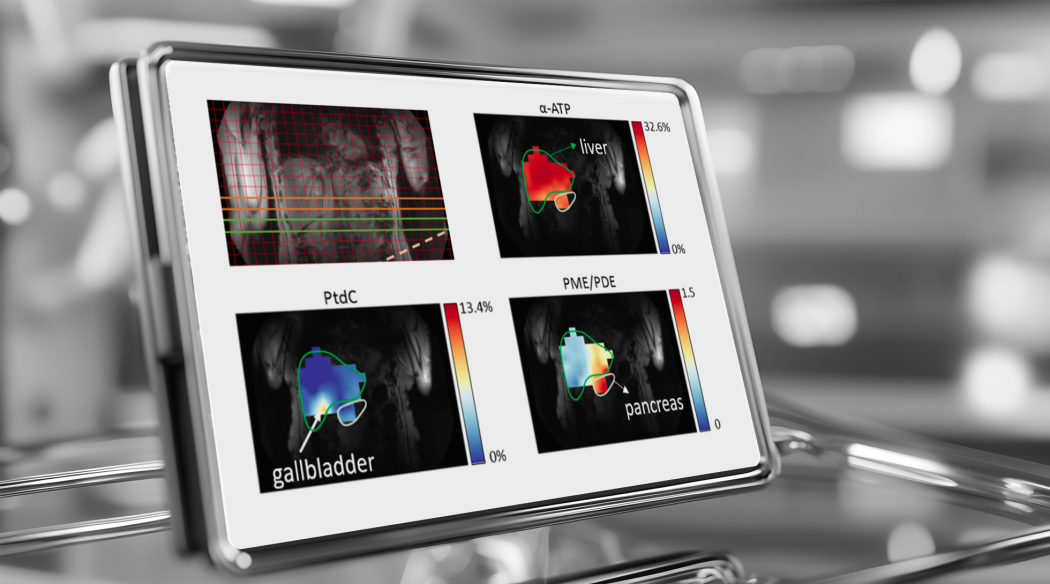
Metabolic-MRI in the clinical setting
ILLUMINATE will demonstrate that metabolic-MRI can improve treatment efficacy through better dosing, preventing side effects, and quickly identifying patients who do not benefit from advanced treatment regimens. Currently about 30% of prostate cancer patients are not responding to the lutetium-177 treatment but still experience side effects that influence their quality of life. Metabolic-MRI could help to better predict which patients will respond and which will not.
Metabolic-MRI also provides the opportunity for more personalized medicine in the treatment of prostate cancer. Currently, the administered dose of lutetium-177-PSMA treatment is the same for every patient. However, every patient and every tumour respond differently to the treatment. Metabolic-MRI allows clinicians to follow the impact of treatment on the tumour in more detail, making it possible to adapt the treatment to the needs of each patient. For instance, clinicians could adjust the doses they administer, which limits the side effects that patients experience when receiving treatment.
The ILLUMINATE consortium is set up to improve availability and use of theranostics. Through ILLUMINATE's clinical study, metabolic-MRI will be used for the optimization of lutetium-177-PSMA theranostics. Imaging techniques are important to determine the efficacy of treatment, which will be improved by implementing novel, broadly applicable, scalable, and highly effective metabolic imaging methodologies. This will be done by further developing metabolic-MRI technologies to non-invasively image cell proliferation and energy metabolism to predict treatment.
First clinical translation of metabolic-MRI for prostate cancer
ILLUMINATE's study will serve as a clinical validation of the metabolic-MRI technology. To date, metabolic-MRI cannot be used in routine care to make decisions about treatment or diagnosis. To enable metabolic-MRI's use for patients in clinical care, ILLUMINATE will develop quantification and decision-making models, and broadly applicable metabolic-MRI decision making tools.
ILLUMINATE will provide the first clinical translation of metabolic-MRI for metastatic prostate cancer and will pave the way for future expansion of the technology for earlier cancer stages or for the use in other cancer types. Besides this, ILLUMINATE will also make the metabolic-MRI available for multiple types of scanners. In this way, more patients can benefit from the technology.